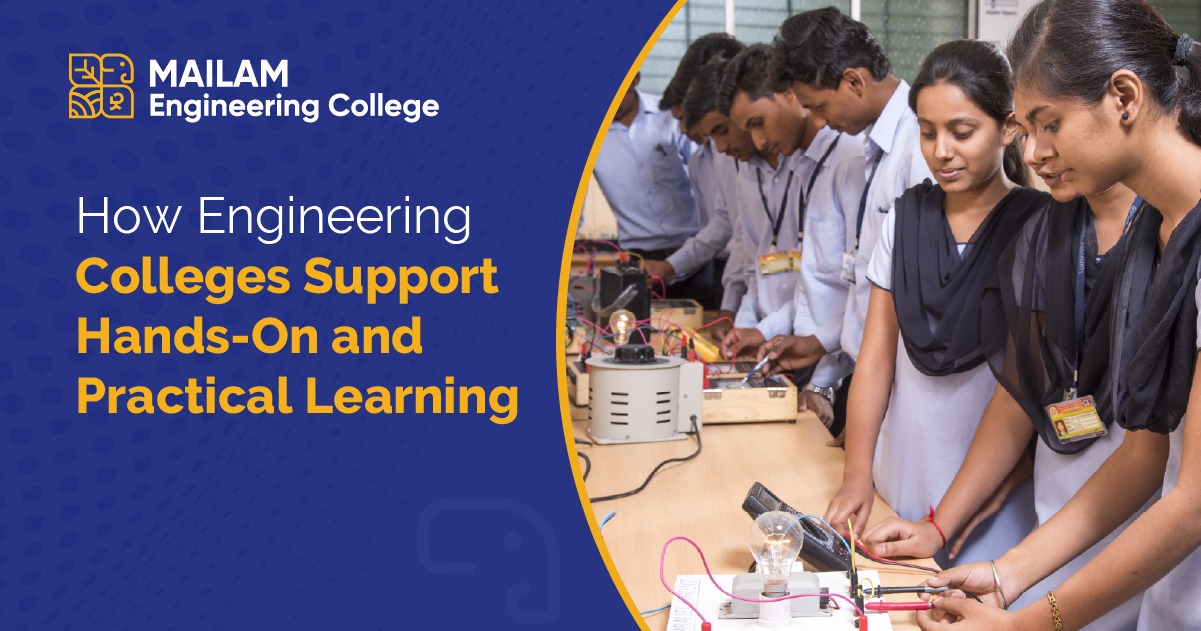
Modern engineering education sets a strong focus on how engineering colleges support practical learning to meet industry expectations.
The trend in institutions now is practical exposure, which can be achieved through advanced labs, projects, internships, etc. These approaches help the student apply concepts learned, provide better problem-solving skills, etc.
Mailam Engineering College focuses on this paradigm of experiential learning whereby students leave the campus with the technical confidence, adaptability, and competence necessary for the real world of engineering careers.
Introduction
Engineering education has evolved beyond classroom lectures, textbooks, and written examinations. Today the Industry expectations are high, whether they are fresh graduates or experienced engineers.
Employers today are looking for skilled and confident candidates who have relevant practical skills as well. This has increased the importance of understanding how engineering colleges support practical learning and give practical exposure to students.
Engineering institutions now focus on experiential learning, with their advanced laboratories along with industry projects. So that their students have knowledge with competence in their fields of study.
We will, through this blog, highlight the ways engineering college added practical learning along with their academic curriculum.
Role of Practical Learning in Engineering
Practical learning means students can apply their theoretical knowledge to solve real-life situations. This learning included the lab work, industrial work, workshops and other activities organised by colleges.
Practical learning has types of learning activities that help students in shaping their careers based on their interests. Unlike the theoretical knowledge, it allows students to analyse, experiment and improve their work by learning from errors.
- Practical leaning with laboratories and workshops
One of the best ways engineering colleges can opt to help students with their practical learning is by having laboratories or organising technical workshops.
Engineering colleges have well-equipped laboratories, which function as the backbone of education, allowing students to have hands-on experience with all manner of equipment, machinery, and technologies.
When thinking about how engineering colleges support practical learning, here is how they support it.
Colleges provide mechanical and manufacturing labs with appropriate tools and testing equipment. Also, the electrical and electronics labs have facilities for circuit design, simulation, and testing.
For students interested in computers, the computer and software labs are also there. Such environments assist students who want to apply theoretical concepts to practice and increase their self-confidence with professional tools.
Some institutions are using virtual and remote labs, giving students a chance to work with simulations too.
- Project-Based Learning as a Core Teaching Method
Another important way in which engineering colleges promote practical learning is through project-based learning.
Rather than limiting assessment to exams, students will be working on real-life projects that require critical thinking, design skills, and collaboration.
This approach from universities or engineering colleges helps students to:
- Develop prototypes of mechanical or electrical systems
- The design of software applications or models for automation.
- Development of sustainable engineering solutions to solve selected local problems.
- Working on interdisciplinary projects with various departments involved.
The study shows students involved in project work are more engaged and better problem solvers.
A report says that 88% of students feel that the learning experience helps them perform well in jobs, which signifies that practical exposure is gaining immense importance.
Industry Collaboration and Internship Programmes
Industry exposure remains an essential factor that influences how engineering colleges support practical learning.
Some organisations work together with engineering colleges to eliminate this perceived disparity between learning and practice.
These collaborations often include:
- Demanding internships or industrial training programs
- Live industry projects are included in the curriculum.
- Guest lectures by industry professionals
- Joint research and development initiatives
In particular, through internships, students are provided with the opportunity to work in real-life engineering environments.
This not only improves their professional capabilities in these environments but also enhances their communication, teamwork, and professional ethic capabilities.
Syllabus Design that Integrates Theory and Practice
Practical sessions are not considered optional additions to the theoretical inputs anymore in modern engineering colleges. Instead, courses are thoughtfully designed that merge theory and practical learning at every level of learning.
This integrated approach ensures that:
- Every theoretical concept is supported by laboratory or project work.
- Assessments include practical exercises, reports and presentations.
- Final-year students usually address real engineering problems through their projects.
- Ability of students to apply knowledge continuously instead of memorising information
By adding practical learning into academic planning, colleges guarantee that students get relevant exposure to practical work regularly during the course.
Learning Beyond Classrooms and Laboratories
Another support that colleges play in student life during their practical learning is facilitating a hands-on mode of learning, which is the promotion of the students taking up extracurricular technical activities.
Learning is not just restricted to the classes; there is also room for activities that help in enhancing the creativity and innovation of the students.
These activities include:
- Technical workshops & engineering events.
- Organising various hackathons and coding competitions.
- Robotics clubs and innovative cells.
- Inter-college technical challenges.
These workshops and events help students to learn leadership, flexibility, and time management. This helps them in the future in a competitive and collaborative arena.
Importance of Faculty Guidance and Mentorship
It is obvious that facilities and programmes alone cannot be considered adequate for a good practical learning outcome.
Faculty members are considered crucial for leading students with the help of practical experiences. Educators are mentors in practical programmes.
They assist with a number of practical learning activities:
- Supervising laboratory and project work
- Encouraging analytical thinking and experimentation
- Assisting students with intricate problem-solving processes
- Facilitating connection with industry experts and opportunities
This mentorship enables students to achieve clarity, confidence, and independence, which are essential in a professional engineer.
Measurable Impact of Practical Learning on Student Outcomes
The importance given to practical learning has demonstrated that there are benefits for engineering students. Institutions where practical learning is emphasised show that there are better academic and placement outcomes.
Studies have established that when learning is experiential, the retention of knowledge is high, and the graduates have better employability.
These outcomes further stress the significance of knowing the role of the engineering colleges in supporting practical learning activities as essential to students selecting that educational institution.
Mailam Engineering College: Where Practical Learning Shapes Future
At Mailam Engineering College, academic success through practical education has a solid foundation. In the institute, there is an open explanation of how engineering colleges support practical learning throughout every step of a student’s journey.
We facilitate practical learning through:
- Advanced laboratory facilities that mirror current industry standards
- Industry-orientated projects and Internships that focus on preparing the students to handle situations in the real world.
- Project-based curriculum design for the consistent application of theory.
- Technical workshops and expert sessions on emerging engineering technologies.
- Student-innovation activities and competitions, as well as tech clubs.
The emphasis given in Mailam Engineering College on experiential learning can benefit its students in terms of acquiring skills, gaining confidence, and being flexible, which are the essentials of engineering in modern working life.
Final thoughts
In the contemporary education system, which is dominated by the concept of outcomes, it is very important to understand how engineering colleges support the practical learning of students.
Practical education not only helps students to become better engineers but also helps them become problem solvers who are geared to deliver in the field.
Mailam Engineering College is an example of an institution that proves how theoretically and practically sound education ensures that the students are not only awarded the degrees but are actually capable engineers too.
FAQs
1. Why is practical learning important in engineering education?
Practical learning is very important as a tool to apply theory, develop problem-solving skills, and make students job-ready professionals.
2. How do engineering colleges provide effective support for learning?
They provide laboratories, industry projects, internships, project-based curricula, and hands-on assessments.
3. What role do internships play in engineering education?
Internships give students exposure to existent engineering environments, which increases employability.
4. Does practical learning improve career prospects?
Employers do value hands-on skills, and experiential learning certainly helps to develop a work-ready person.
5. How does Mailam Engineering College promote practical learning?
Mailam engineering college also provides facilities like lab facilities, projects, and industry exposure with technical activities.